Google and Telstra have formed a strategic infrastructure partnership to expand the reach, resilience, and security of Australia’s digital networks by combining terrestrial fibre and subsea cable assets. The agreement gives Google access to capacity on Telstra’s Aura Network terrestrial backbone while enabling Telstra to utilize fibre pairs on Google’s Tabua, Proa, and Bulikula subsea cable systems. The companies said the collaboration will strengthen connectivity across Australia and key international routes linking Australia with Japan, the Pacific Islands, and the United States.
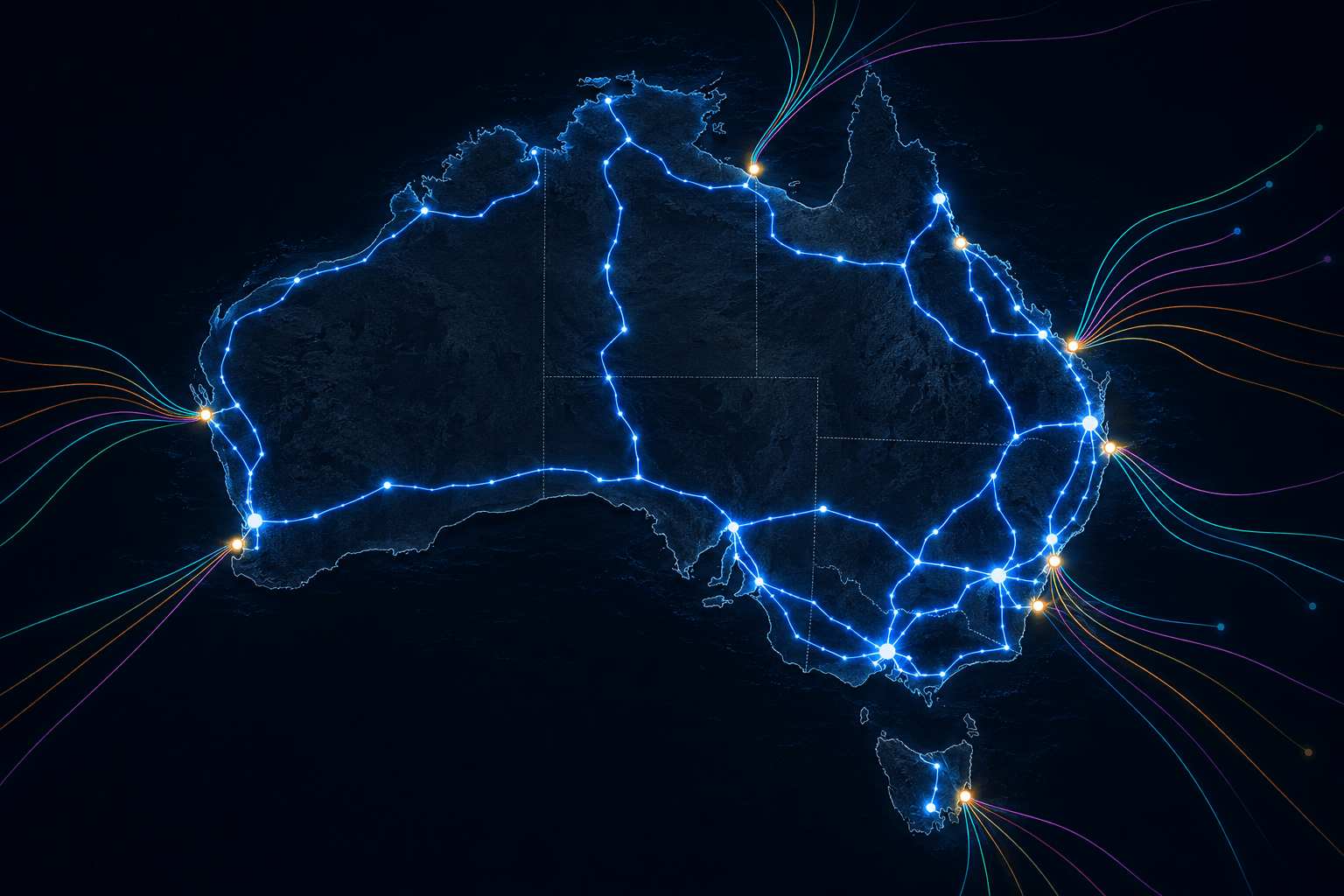
The partnership reflects growing demand for AI-ready infrastructure as hyperscalers, cloud providers, enterprises, and governments require higher-capacity and more resilient network paths. Google will secure inter-city dark fibre capacity on Telstra’s Aura Network, which now spans more than 8,000 kilometers (approximately 4,970 miles) across Australia. Telstra, meanwhile, gains access to Google’s Pacific Connect and Australia Connect initiatives, providing additional subsea diversity and international connectivity options. By integrating terrestrial and subsea routes, both companies aim to reduce single points of failure and improve network resilience.
The agreement also reinforces Australia’s role as a regional digital hub. Google said the infrastructure will support the delivery of AI services and cloud applications across the country, while Telstra highlighted the importance of building secure and scalable connectivity capable of supporting future AI workloads and data-intensive applications. The companies view the combined infrastructure footprint as a foundation for economic growth, cloud expansion, and broader participation in the digital economy throughout the Asia-Pacific region.
- Google will secure dark fibre capacity on Telstra’s Aura Network backbone.
- Telstra will access subsea fibre pairs on Google’s Tabua, Proa, and Bulikula cable systems.
- The partnership combines terrestrial and subsea infrastructure to improve network resilience.
- Aura Network now includes more than 8,000 kilometers (4,970 miles) of fibre infrastructure across Australia.
- International connectivity routes will link Australia with Japan, the Pacific Islands, and the United States.
- The infrastructure is intended to support increasing AI, cloud, and data-intensive workloads.
- Both companies position the partnership as strengthening Australia’s role as a regional connectivity hub.
“Building digital infrastructure capable of supporting the next wave of AI innovation requires deep collaboration and robust physical networks,” said Bikash Koley, Vice President, Global Infrastructure, Google. “This partnership brings together Google’s global subsea capabilities and network innovations and Telstra’s terrestrial reach to ensure Australians have the secure, high-capacity, and resilient digital services they require to compete globally.”
| Telstra Infrastructure / Asset | Type | Overview & Capability | Key Routes / Reach |
|---|---|---|---|
| Aura Network | Terrestrial Fibre Backbone | Telstra InfraCo’s state-of-the-art intercity backbone. A $1.6B investment spanning over 14,000 km of ultra-low-loss fiber. Built for AI workloads, it delivers up to 35x the capacity of legacy networks (up to 83.6 Tbps per path). | Links major capital cities (Sydney, Melbourne, Brisbane, Canberra, Adelaide, Perth) and critical regional data hubs. |
| Indigo West & Indigo Central | Subsea Cable System | Telstra is a founding consortium member and primary capacity owner in this high-capacity subsea system, anchoring Western Australia to Southeast Asia. | Perth–Singapore (Indigo West) and Perth–Sydney via Adelaide (Indigo Central). |
| JGA South (Japan-Guam-Australia) | Subsea Cable System | Consortium cable providing a vital, high-speed direct bypass route from Australia’s east coast up to the Guam trans-Pacific gateway hub. | Sydney and Sunshine Coast to Piti, Guam (with onward seamless transit to Japan via JGA North). |
| APG (Asia Pacific Gateway) | Subsea Cable System | Consortium-owned system leveraging massive multi-terabit capacity to connect the primary financial and digital markets of East Asia. | Japan, South Korea, Mainland China, Taiwan, Hong Kong, Vietnam, Malaysia, Singapore, and Thailand. |
| SEA-ME-WE 3 | Subsea Cable System | One of the longest littoral cable systems in the world. Telstra maintains extensive long-standing capacity interests for global route redundancy. | Australia to Southeast Asia, the Middle East, and Western Europe. |
| PPC-1 (Pipe Pacific Cable 1) | Subsea Cable System | Major international subsea trunk line. Telstra holds extensive, long-term capacity rights and fiber pairs inherited via its Pacnet infrastructure acquisition. | Sydney to Guam, providing critical diverse routing options away from traditional Asian choke points. |
| Telstra Global Portfolio | Global Capacity Network | The largest subsea cable network infrastructure footprint in the Asia-Pacific region, blended across wholly-owned assets, consortiums, and IRUs (Indefeasible Rights of Use). | More than 30 countries and territories spanning APAC, North America, Europe, and the Pacific Islands. |
| Strategic Google Partnership (2026): A major vertical network integration infrastructure swap. Google secures foundational terrestrial inter-city dark fiber capacity on Telstra’s next-gen Aura Network to anchor its AI workloads. In return, Telstra gains direct subsea fiber pair access across Google’s Pacific Connect and Australia Connect initiatives—specifically utilizing the Tabua, Proa, and Bulikula subsea systems to build a highly resilient, self-healing data ring connecting Australia, Japan, the US, and the Pacific Islands. | |||
🌐 Analysis: The Google-Telstra agreement highlights an increasingly vital playbook for the AI era: the vertical convergence of hyperscale cloud architecture and terrestrial telecommunications. We are moving past the era of simple capacity leasing; hyperscalers like Google, Meta, and Microsoft are aggressively funding and swapping infrastructure to build custom, end-to-end data pipelines.
This specific partnership represents a highly strategic “land-for-sea” trade:
What Google Gets: Vital, high-capacity terrestrial dark fiber via Telstra’s $1.6B Aura network, allowing Google to seamlessly backhaul massive cloud and AI workloads from oceanic landing points to its inland data center hubs.
What Telstra Gets: Unprecedented subsea route diversity and redundancy through Google’s Pacific Connect and Australia Connect initiatives (Tabua, Proa, and Bulikula).
For Telstra, the agreement firmly cements its position as the undisputed digital gateway of the South Pacific. More broadly, it underscores how international route diversity is no longer just a backup plan for emergencies—it is now a fundamental requirement for distributed AI training, low-latency cloud inference, and sovereign digital infrastructure.
🌐 We’re tracking the latest developments in subsea cable infrastructure, policy, and deployments. Follow our ongoing coverage at: https://convergedigest.com/category/subsea/
🌐 We’re launching the “Data Center Networking for AI” series on NextGenInfra.io and inviting companies building real solutions—silicon, optics, fabrics, switches, software, orchestration—to share their views on video and in our expert report. To get involved, send a note to [email protected] or [email protected].