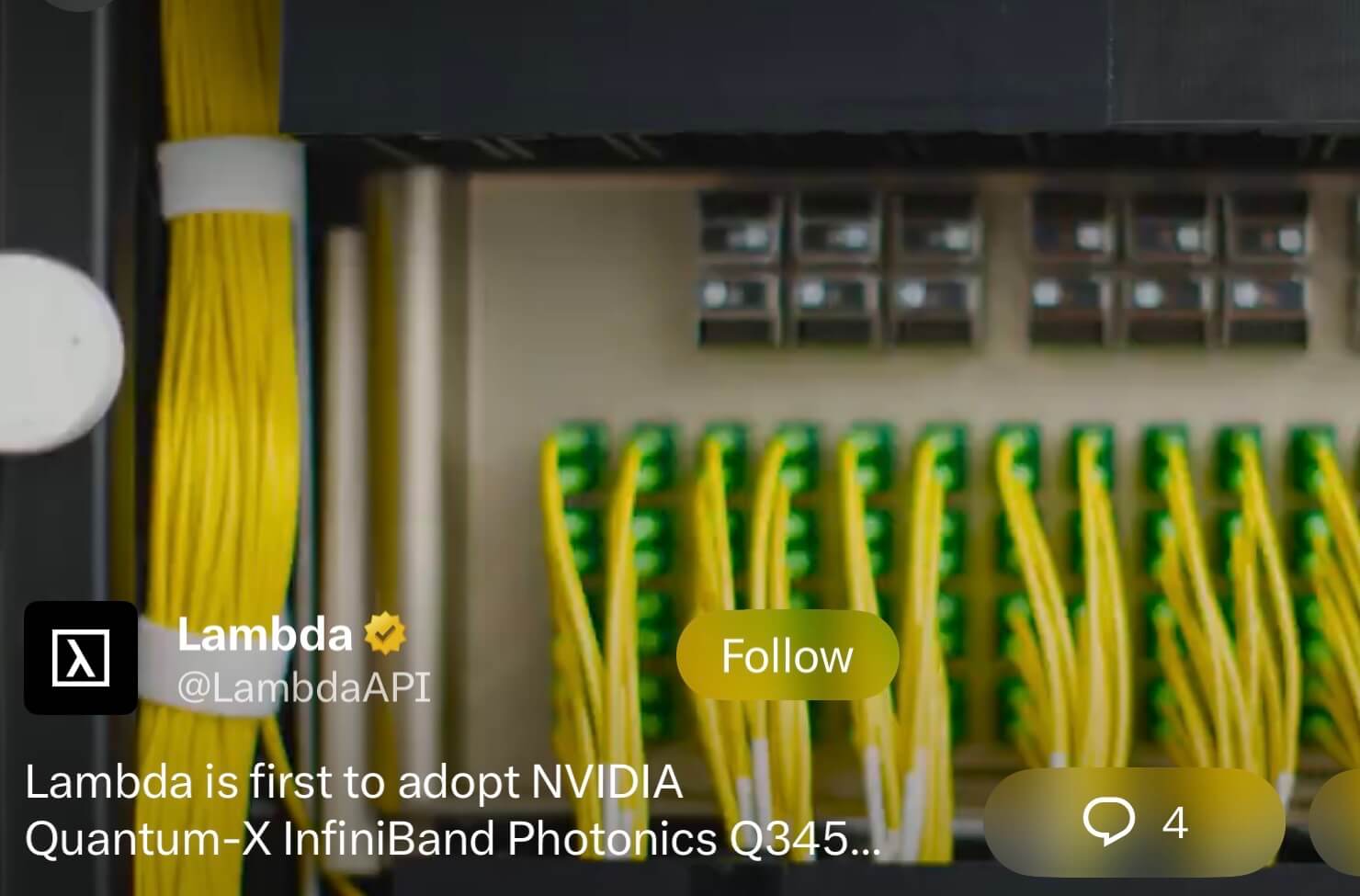
Lambda is taking an early look at co-packaged optics (CPO) as it builds out infrastructure for large-scale AI clusters based on NVIDIA GB300 NVL72 systems. In a new engineering post, the company describes its evaluation of the NVIDIA Quantum-X Photonics Q3450-LD, a liquid-cooled 144-port 800G InfiniBand switch that integrates silicon photonics directly alongside the switch ASIC. Lambda frames the move around a growing challenge in AI infrastructure: the network is becoming part of the compute envelope rather than a supporting layer.
The company says this is especially important for agentic AI workloads, where a single inference request can trigger multiple model calls, retrieval steps, tool invocations, and reasoning passes across a cluster. That creates heavier east-west traffic and places the network directly in the token-generation path. In large three-layer GPU fabrics operating at 800G, Lambda estimates the back-end network can account for as much as 86% of total networking power. By reducing switching-layer power consumption, CPO can free additional facility power capacity that operators may choose to allocate toward compute rather than networking overhead.
Lambda cites both power and operational reliability as drivers. The company estimates a traditional 128,000-GPU deployment using pluggable optics would require roughly 655,000 discrete transceiver modules across the switching fabric. Co-packaged optics eliminates that class of pluggable optical module, reducing component count and removing digital signal processors from the optical path. Lambda says this can lower switch power draw while reducing failure points in large clusters, where network instability can directly affect GPU utilization and token throughput.
- Switch platform: NVIDIA Quantum-X Photonics Q3450-LD
- ASIC: NVIDIA Quantum-X800
- Ports: 144 x 800G InfiniBand
- Switching capacity: 115.2 Tbps non-blocking
- Form factor: 4U
- Power: 48V DC busbar input
- Cooling: Dual-loop liquid cooling
- Optics: 144 MPO fiber connectors with 18 removable external light-source modules
Lambda says the operational model around CPO also changes compared with pluggable optics-based systems. The switch uses fiber-array connections in place of OSFP cages, with optical conversion occurring directly next to the ASIC. That shortens the electrical path from centimeters to micrometers, reducing signal loss and eliminating the need for onboard DSP compensation. Installation requires tighter coordination across rack design, power delivery, liquid cooling, and fiber routing. Lambda notes that working with NVIDIA on engineering samples allows both teams to validate those procedures before volume deployment.
As Ashkan Seyedi noted in the post: “Multi-agentic inference needs elastic and resilient data movement, so GPUs are not waiting for data, while maintaining tokens per second and fast time to first token.”
🌐 Analysis: Lambda’s evaluation of co-packaged optics reflects a broader shift in AI infrastructure design, where networking efficiency is becoming as important as accelerator density. As GPU racks move toward 100 kW+ power envelopes and cluster sizes expand into tens of thousands of GPUs, switch power, optical interconnect density, and network reliability are emerging as limiting factors alongside compute availability. NVIDIA’s Quantum-X Photonics platform is among the first commercial attempts to move CPO into production AI fabrics.
The timing also aligns with wider industry momentum around silicon photonics and optical integration. Companies including Broadcom, Marvell, and NVIDIA are all investing heavily in photonic interconnect strategies for AI infrastructure. The next phase of AI cluster design will likely be defined not only by faster GPUs, but by how efficiently operators can move data between them.